Op-ed, LLM Weaponisation
The Weaponisation of LLMs: Why Indian Startups Must Pay Attention
It highlights the importance of AI sovereignty, model-agnostic architectures, proprietary data, and indigenous AI capabilities in building resilient and globally competitive startups.

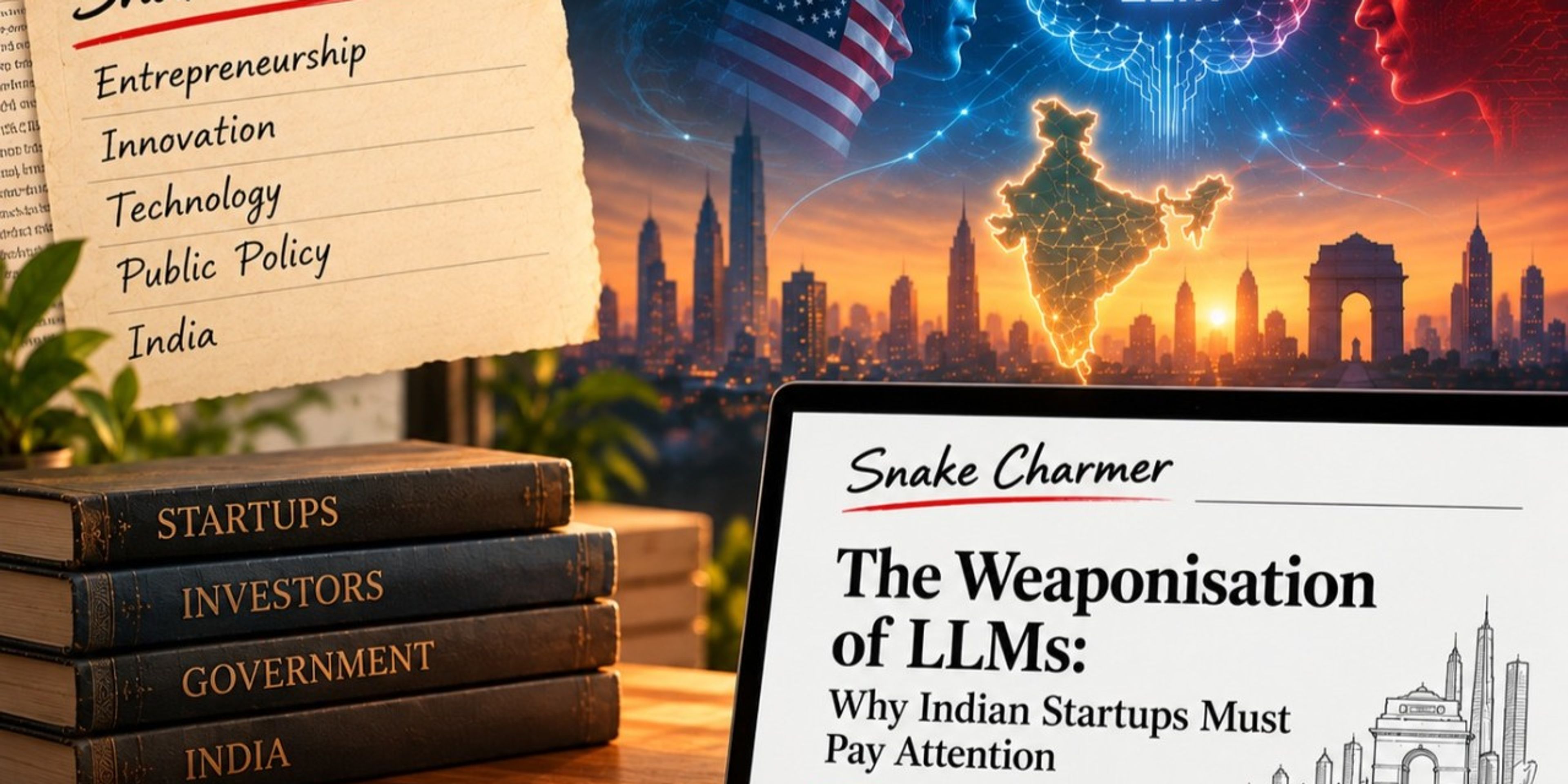
As the US and China turn artificial intelligence into an instrument of economic and geopolitical power, Indian startups must rethink their dependence on foreign AI models
Artificial intelligence was supposed to democratise innovation. A startup in Bengaluru could access the same powerful language models as a Silicon Valley company, without investing billions in computing infrastructure. But this promise is increasingly colliding with geopolitical realities.
The emergence of China's DeepSeek, America's restrictions on advanced semiconductor exports, and the growing dominance of a handful of AI companies signal a fundamental shift. Large Language Models (LLMs) are no longer merely technological products. They are becoming instruments of economic influence and strategic power.
China is expanding its AI ecosystem through affordable, increasingly capable open-weight models. American companies such as OpenAI and Anthropic retain significant advantages in frontier research, computing infrastructure and commercial platforms. While their models remain accessible internationally, access is subject to commercial policies, regulatory restrictions and changing geopolitical considerations.
The real weaponisation of AI may not lie in denying access, but in creating dependence.
For Indian startups, this creates what I call the AI Dependency Trap. Entrepreneurs build innovative products on foreign LLMs, acquire customers and attract investment, but gradually surrender control over the intelligence powering their businesses.
This dependence has three dimensions: technological, where products become inseparable from specific models; economic, where API pricing determines profitability; and strategic, where decisions by foreign companies or governments can disrupt operations.
Consider an Indian healthcare startup using a foreign LLM to process clinical records. What happens if the provider doubles its prices, changes its data policies or introduces competing functionality? The startup may own the customer relationship, but not the intelligence infrastructure sustaining it.
For investors, this raises an uncomfortable question: Are we funding genuinely differentiated AI businesses or merely applications renting intelligence from global technology companies?
The answer is not technological isolation. Indian startups must embracearchitectural independence: designing products that can switch between American, Chinese, Indian and other models while developing proprietary datasets, specialised workflows and domain expertise.
India's ₹10,372-crore IndiaAI Mission is an important step towards strengthening domestic capabilities. However, success should not be measured merely by GPUs deployed or indigenous models developed. The real measure will be globally competitive businesses emerging from this infrastructure.
Universities, incubators and investors must prioritise startups that convert AI capabilities into defensible intellectual property and measurable business outcomes, particularly in healthcare, agriculture, manufacturing and financial services.
India need not replicate every frontier model to become an AI powerhouse. Its opportunity lies in building specialised intelligence that addresses complex, real-world problems at scale.
The US and China may compete to control the production of machine intelligence. India must ensure that its entrepreneurs retain control over how that intelligence creates value.
In the emerging AI economy, the greatest risk is not being left behind in the race to build LLMs. It is building an entire generation of startups whose competitive advantage can be switched off by someone else.